The Steps course takes place in tutorial groups and comprises, in part, lots of worksheets. Some children will enjoy this approach, but others will not. You might also think, like we do, that children spend quite enough time in classrooms already, and need more time for play.
So I prefer to promote chess using short and enjoyable games which children can play at home with their family and friends whenever they want.
Chess can be divided, roughly, into TACTICS and STRATEGY. Tactics is about winning pieces and checkmating the enemy king, and usually uses the more powerful pieces (queen, rooks, bishops and knights). Strategy is about long-term planning, and usually involves the short-stepping pawns.

Our first set of minichess games is all about capturing. We might start with this one, in which two bishops battle with two rooks. The first player to make a capture wins. If you’re not sure of the rules you can download our handy guide here. You can start with the pieces on different squares, play rook and bishop against rook and bishop, play with a queen against two other pieces, play with two knights against two rooks or do whatever you want. Children can be encouraged to invent their own games along these lines.
These games teach all sorts of things: they reinforce the moves of the queen, rook, bishop and knight, they help beginners develop the absolutely vital skill of chessboard vision, and, extrinsically, they help children improve their self-control.
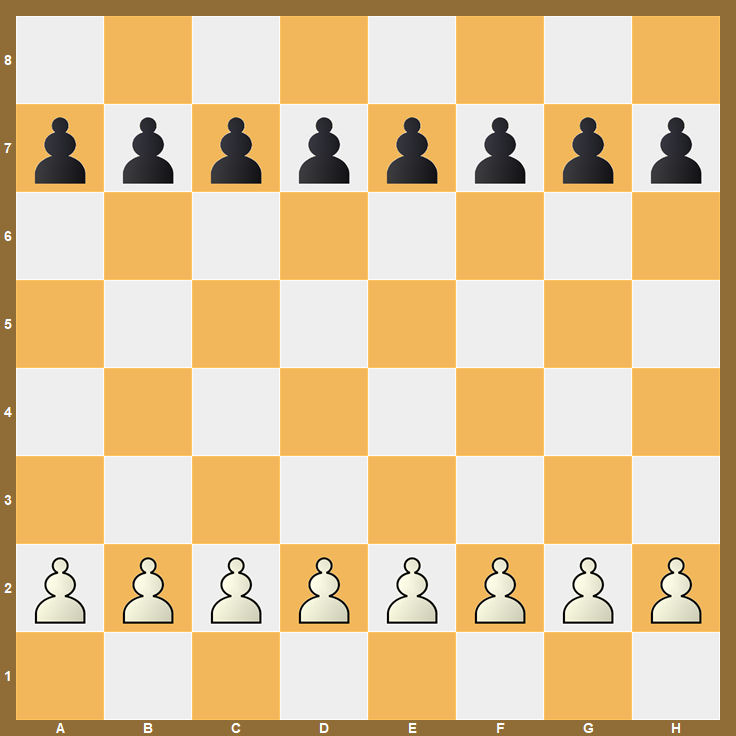
Then we teach strategy by way of the PAWN GAME. This is the full version. White starts and the first player to get a pawn to the end wins. In our rules you also win if you take all your opponent’s pawns or if you’re opponent can’t move. If you want you can start with fewer pawns each to make the games easier and quicker. If I’m playing with a pupil I’ll usually take one or two of my pawns off the board at the start to even up the game. Here, there are fewer choices than when you’re playing with the more powerful pieces so you can learn to form plans, look ahead and anticipate your opponent’s reply. All this can, if you wish, be translated into both cognitive and life skills.

We then add the two together in games in which a piece battles against an army of pawns. In these games, White wins by capturing the enemy pawns, while Black wins by getting a pawn to the end of the board safely (where it can’t be captured). The game on the left is a great exercise and surprisingly difficult to play well.

The game on the right, although easier to play, is also a great exercise requiring an understanding of double attacks as well as the ability to think ahead.
You can also play with a rook or a knight against pawns. Try out different numbers of pawns, and pawns on different files (vertical rows) and ranks (horizontal rows). Encouraging children to try out their own games is great for improving their creativity.
There are so many different games children can play within these parameters, all only taking a few minutes to complete and much more suitable for most young children than complete games of chess.
Children should be encouraged to learn to play these games well: to think about what they’re doing and why they’re doing it. This way they’ll gain a lot of cognitive and life skills as well as chess skills which will enable them to learn to play a proficient game of ‘big chess’ quickly when the time comes.
We hope they’ll also have a lot of fun in the process.
 Twickenham Library Junior Chess Club