Let’s start with this, which you’ll find in various places on the internet.
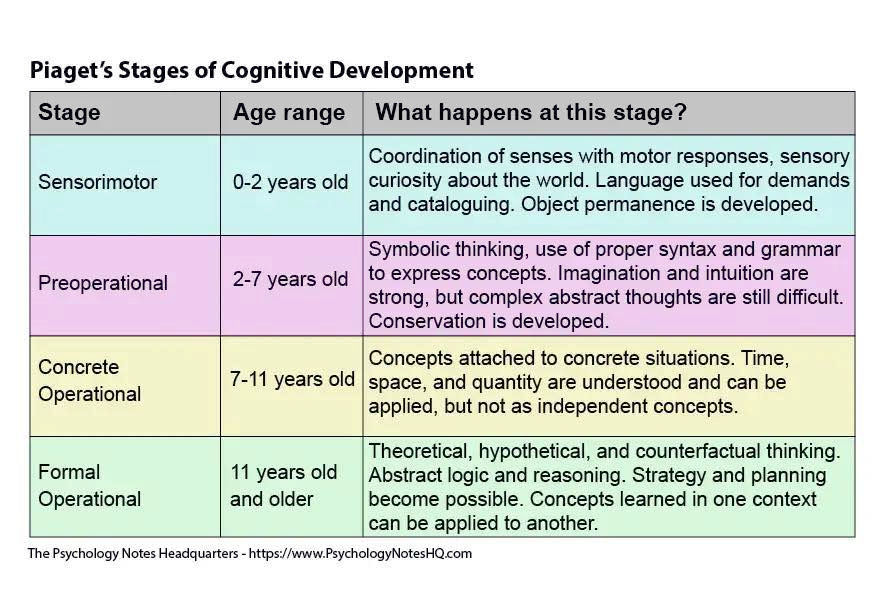
Yes, I know there’s been much criticism of Piaget, and quite rightly so as well, but this will serve as a starting point.
I would consider learning how the pieces move to be a Concrete Operational activity, suitable for children aged between 7 and 11. Years 3 to 6 at Primary School if you like. In fact most children will be able to pick up the moves earlier, maybe at age 5 or 6, but because ‘complex abstract thoughts are still difficult’, without a lot of adult help is that they won’t have much idea what to do with them.
(Perhaps my main problem with applying Piaget to chess is that children can be taught to perform tasks appropriate for older children using repetition and reinforcement. But if they’re only doing chess once a week at school that won’t happen.)
I would consider playing a proficient game of chess to be a Formal Operational activity, suitable (in general terms) for children of secondary school age. When I’m playing chess I’m using, or at least trying to use, ‘theoretical, hypothetical and counterfactual thinking, abstract logic and reasoning, strategy and planning’. I’m also applying concepts learned in one context to another – if I’ve seen a similar position before I’ll have a much better idea of what to do.
Other sources give other definitions of the Formal Operational Stage, mentioning inductive and deductive reasoning, developing complex hypotheses using abstract thought and general principles. Children at this stage are concerned with the hypothetical and the future, can create and test hypotheses. They begin thinking in a formal, systematic way.
All this is exactly what you have to do to play a good game of chess.
Where Piaget falls over is that some children as young as 7 can play chess to a very high level. I’m a pretty strong (by most standards) and very experienced player, but some of them would even beat me. Why? Because they’re exceptional children with exceptional parents.
Perhaps your children will want to take this route. But, for most children, it’s better to start with simpler games before moving onto ‘big chess’. Which is exactly where we come in.
“
 Twickenham Library Junior Chess Club